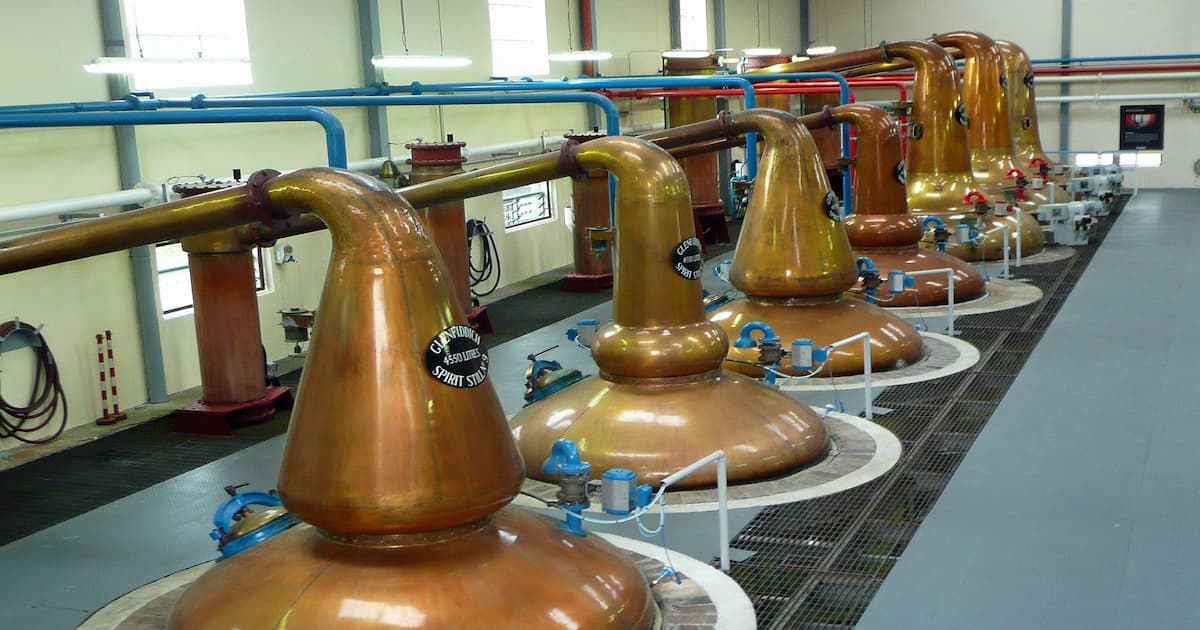
Whisky stills are where the magic of distillation happens. Let me cover their history first, then the two great families: pot stills and column stills.
The History and Characteristics of Stills
Distillation is a physical method of separating a mixture of two or more liquids using relative volatility — put simply, differences in boiling point. It began around 2000 BC in the Babylonian region of Mesopotamia. The technique reached ancient Greece in the 1st century, where distilled spirits began to be produced in volume. Then, in the 8th century, the distilling apparatus refined by Islamic chemists became the mother of the modern still. Development never paused in the centuries that followed, accelerating spirit production and giving rise to whisky and the other high-proof drinks we enjoy today.
Let’s zoom in on whisky distillation specifically. Distilling whisky means separating the alcohol from wash, a liquid of about 5–8% ABV. If you are curious what wash is and how it is made, please see my earlier post, “How Whisky Is Made.” Back to the point: alcohol boils at 78°C at standard atmospheric pressure, notably lower than water’s 100°C. The alcohol therefore vaporizes first and is separated out ahead of the water.
Distillation, of course, requires a still. Stills divide broadly into pot stills and column stills. The underlying mechanism within each family is the same, but every distillery’s stills differ in shape, size, height, heating method, the angle of the lyne arm, the form of the head, and more — and those differences are what give each distillery its own signature flavor.
Pot Stills
As mentioned, stills split into pot stills and column stills. Let’s start with the pot still, the most widely used of the two.
A pot still distills in single batches, exactly as the name suggests. After each run, the residue left inside must be emptied out and the still cleaned before the next run can begin. Since whisky distillation rarely ends after one pass, the process is repeated several times over. A great share of whisky — single malts above all — is distilled this way. The pot still is the traditional method, operating on nearly the same principles as the apparatus those 8th-century chemists devised.
Pot stills are made of copper. Copper strips out sulfur compounds, removing off-flavors and harmful elements, and during distillation it generates esters that lend fruity aromas. The more contact the distillate has with the copper, the more of these benefits it gains. Increasing the contact area per unit of volume means building the still smaller — at the cost, of course, of a smaller yield per run.
The construction varies from distillery to distillery, but a pot still generally consists of a body, shoulders, a head, a neck, and a lyne arm. How large each part is made, the shape of the head, the angle at which the neck bends — all of it weighs heavily on the distillation.
Still shapes are countless, but three dominate: the boil ball type, the lantern type, and the straight-neck type. The boil-ball still keeps components other than alcohol from distilling over, producing a clean, crisp whisky. The lantern still lets vaporized alcohol fall back into the wash at its pinched waist, creating an effect similar to re-distillation. And the straight-neck still allows flavors beyond the alcohol itself to carry over into the distillate.
Next, the lyne arm, which can angle upward, sit level, or angle downward. An upward arm drives strong reflux — much like a tall-necked still — and yields a light distillate. A level arm, bent to the horizontal, imparts a pronounced nutty flavor. A downward arm does the opposite of the upward one, producing a heavy, oily-textured distillate.
Once distillation is complete, the foreshots and feints are removed and only the middle cut is drawn off for use. For the details, please see “How Whisky Is Made.”
Column Stills
The column still is a comparatively recent invention — an entirely new design rather than a descendant of the old pot still. It was devised by Robert Stein in the early 19th century, and later refinements produced the modern column still.
Where a pot still stops after each run for emptying and cleaning, a column still never stops — it distills continuously. For that reason, if a distillery can shoulder the initial installation cost, the column still holds an overwhelming advantage in production cost and speed. Its fatal weakness: it cannot impart anywhere near the flavor a pot still can. It is generally used for distilling grain whisky.
Here is the principle in brief. A column still is a tall cylinder, divided inside into levels by a series of plates, heated from the bottom. Wash enters at the middle level and trickles down, filling each level below. Heated from beneath, the vapor that distills off rises to the level directly above, where it heats that level’s wash; what distills there rises again, and the cycle repeats upward. Components that fail to distill condense, mix back into the wash, and fall back down.
When distillation is done, each level holds distillate with its own composition and flavor. The levels below the wash-entry point serve as separation levels; those above are the distillation levels. The lower levels carry the heavy components, the upper levels the light ones — and the very top contains not just ethyl alcohol but toxins such as methanol, dangerous to drink. Just as the foreshots are discarded from a pot still, the dangerous topmost level is excluded, and the level from which the distillate is drawn determines the flavor of the whisky spirit. For whisky, it is usually taken from a level running at about 85% ABV.
Next up: “All About NAS Whisky: What NAS Whisky Is, Why It Is Made, and Famous Distilleries“
Thank you for reading.
Leave a Reply